

Green supply chains at risk: measuring the true economic and environmental costs
by Maria-Grazia Attinasi, Lukas Boeckelmann, Bernardo de Castro Martins, Baptiste Meunier, Alessandro Borin, Francesco Paolo Conteduca, Michele Mancini[1]
Our new methodology builds an inter-country input-output table that distinguishes green products from the rest, allowing us to assess vulnerabilities in green value chains. In a multi-country, multi-sector model, our table reveals that a decoupling of green supply chains between a US-centric West and a China-centric East could globally cut trade in green products by up to 20%, lower welfare by up to 3% and raise yearly global greenhouse gas emissions by about 50 million tonnes.
Uncovering the supply chains of green products
In Attinasi et al. (2025) we examine how trade barriers, when targeted at products crucial for the green transition, can affect the global macroeconomy and greenhouse gas emissions. A number of recent trade policies have specifically targeted this category of goods, including the US Inflation Reduction Act (August 2022), the US tariffs on Chinese electric vehicles and batteries (May 2024) and the EU tariffs on Chinese electric cars (July 2024). In this context, we investigate what happens when countries restrict trade in environmentally friendly products – like electric vehicles and renewable energy equipment – and so disrupt the global supply chains of green products.
Input-output tables map the flow of goods and services between industries. But existing input-output tables are not well suited to analysing the supply chains of green products, as they bundle green and non-green products together by country and sector (see Bolhuis et al., 2023, and Conteduca et al., 2025, for a general discussion of caveats related to the bundling of sectors in input-output tables). For example, standard input-output tables lump electric and non-electric cars together in one “motor vehicles” sector. This masks the specific interlinkages between sectors in the production pipelines for electric cars versus cars with combustion engines. It is a particular problem when using multi-country, multi-sector general equilibrium models (e.g. the model proposed by Baqaee and Farhi, 2024) that are calibrated on input-output tables. With existing input-output tables, it’s impossible to simulate substitution between green and non-green goods, or sector-level effects for green products, unless we can distinguish the green products from the others in the tables. Moreover, aggregating whole sectors in these tables can result in models underestimating the scale of trade shocks.
Constructing an input-output table that screens for green goods
To overcome this problem, we developed a new methodology allowing us to build tailored input-output tables isolating specific products – and we applied it to green products. Our methodology breaks down the broad economic sectors of the input-output tables into smaller sub-categories. In our application, we separated 129 products critical for the green transition (e.g. electric vehicles and solar panels, gallium and palladium, and lithium cells and batteries) from other, non-green goods.
We identified these green products based on recent policies and government assessments. For example, we included products targeted by the US Inflation Reduction Act or products related to the green transition that are listed in the EU Commission assessment of strategic dependencies. We then grouped those green products into eight aggregated green input sectors: mined rare earth, processed rare earth, chemicals for the green transition, electric batteries, renewable energy mechanical equipment, renewable energy electrical equipment, electric vehicles and green electricity. For that purpose, we used detailed trade data to identify two-way export flows in green and non-green products.
In order to see which economic sectors import which green and non-green products and to construct production pipelines between the two product groups, we enhanced the trade data with information on supply chain linkages taken from academic literature and industry reports. This allowed us to construct a tailored input-output table describing the global sectoral interlinkages specific to green products.
Chart 1
Geoeconomic fragmentation into western, eastern and neutral blocs
Source: Attinasi et al. (2024).
Notes: Countries are allocated mechanically to a geopolitical bloc based on geopolitical indices by den Besten et al. (2023) and Capital Economics. The indices rely on information such as the history of sanctions, military imports, UN voting, territorial disputes, China’s official lending, bilateral foreign direct investment flows and trade.
Modelling supply chain decoupling in green products
Using this enhanced input-output table, we study a hypothetical scenario in which a China-centric East and a US-centric West stop trading green products with each other, while a third bloc of neutral countries remains unaffected by restrictions. To do this, we adapt a multi-country, multi-sector general equilibrium model (as in Baqaee and Farhi, 2024) using the input-output table and then simulate trade fragmentation in green products. We allocate countries to different geoeconomic blocs (Chart 1) based on whether they share similar political values, economic policies and security interests, as in Attinasi et al. (2024), Gopinath et al. (2025) or Javorcik et al. (2024). Geoeconomic fragmentation between a China-centric East and a US-centric West is a simplifying assumption, as trade fragmentation can also occur within countries of the same bloc. For example, the historically high tariffs which the United States imposed in 2025 were not only directed at countries in the neutral or opposing bloc, but also at close allies, such as EU Member States.
Our findings suggest such trade fragmentation has significant economic fallout. Higher barriers to trade create an import price shock, reducing imports and welfare. As a result of the price shock, producers and consumers substitute away from more expensive imported products from the opposing bloc towards products from either their own bloc or the neutral one, creating a positive demand shock for the latter. Chart 2 (panel a) shows trade between West and East tumbling by around 15%, while trade within the same bloc and with the neutral bloc edges up between 1% and 4%, suggesting that trade is diverted. World trade in the product groups targeted by the “green trade war” declines 10%-20%. The most affected product groups are green chemicals and renewable energy equipment, since these products were largely traded between East and West before fragmentation (see Chart 2, panel b).
Chart 2
Trade effects of a supply chain decoupling in green products
(percentage deviation from steady state)
a) Bilateral real imports |
b) Global real imports |
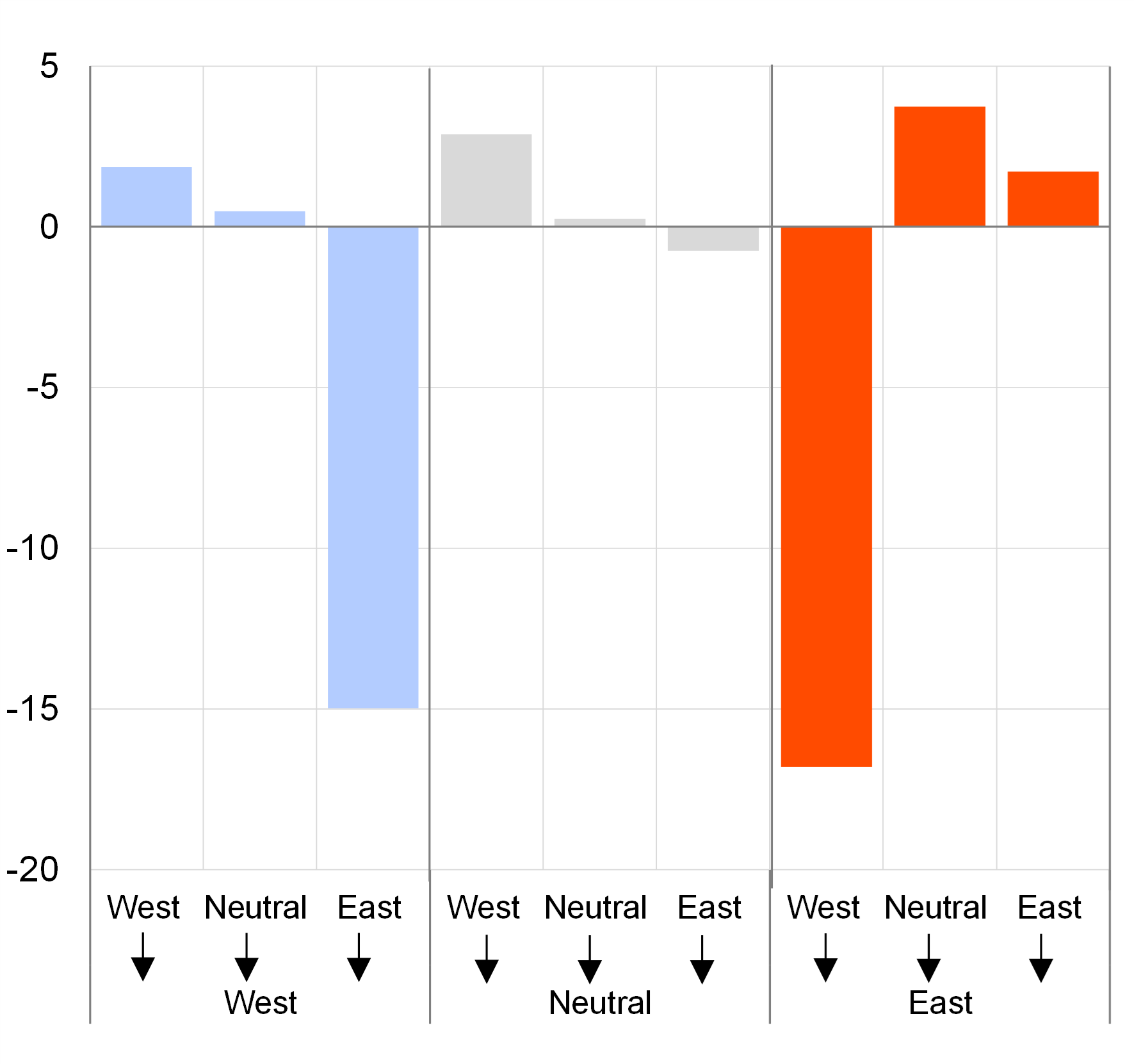
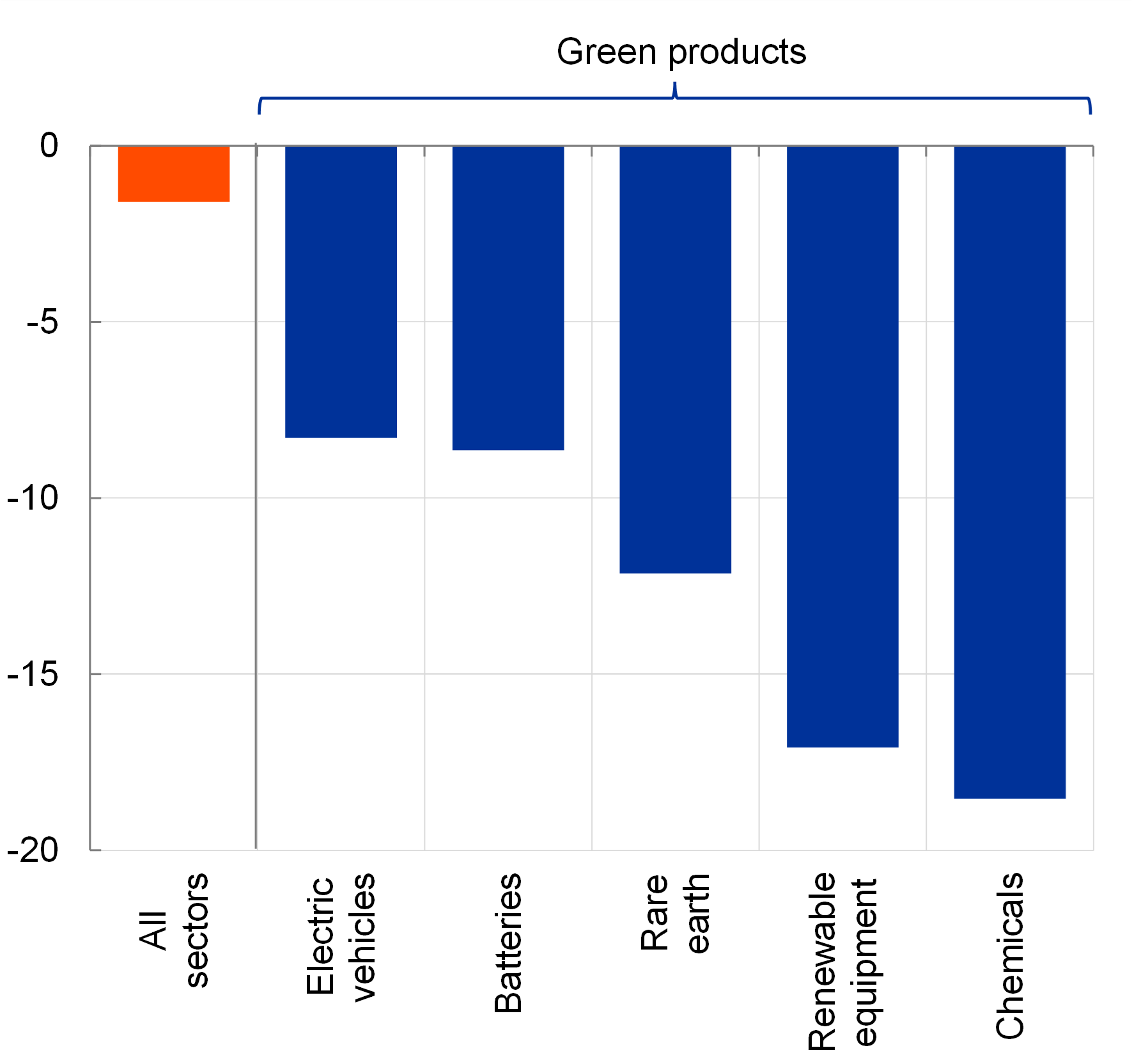
Sources: Baqaee and Farhi (2024); Attinasi, Mancini et al. (2024); the OECD Trade in Value-Added database; the International Energy Agency; the CEPII-BACI dataset; and the authors’ calculations.
Notes: Panel a): trade effects for green and non-green products; panel b): “All sectors” refers to trade in green and non-green products, while blue bars refer to trade in green products. “Renewable equipment” refers to renewable energy equipment, both mechanical (e.g. wind turbines) and electrical (e.g. solar panels). “Chemicals” refers to chemicals necessary for the green transition. The non-linear impact is simulated through 25 iterations of the log-linearised model.
In terms of welfare, both opposing blocs would lose out, as trade barriers increase the prices of all green products and reduce opportunities to trade those produced domestically. Welfare losses are higher in the China-centric bloc, where they decline by as much as 3%, while in the US-centric bloc they decline by up to 2%. Trade fragmentation makes green products more expensive worldwide relative to non-green products, with downstream goods such as electric vehicles facing particularly sharp increases.
This undermines the adoption of green technologies, leading to higher greenhouse gas emissions in the global economy. The cumulative additional emissions over 20 years are comparable to a year’s emissions from a large country such as Japan or Brazil. In fact, the effects on greenhouse gas emissions could be even higher than we estimate: innovation in green technologies could slow further if higher prices for foreign alternatives reduce competitive pressure, in turn reducing domestic firms’ incentives to invest in improving their products.
Overly broad input-output matrices can mask reality
Our findings show that when models use input-output tables bundling whole sectors together, the results can mask the true scale of trade shocks. To illustrate this, we estimate stylised scenarios of autarky, meaning economic self-sufficiency, on detailed input-output matrices with twice or even three times more sectors than in standard input-output matrices. These stylised scenarios produce substantially larger impacts on welfare and consumer-prices (Chart 3, panel a). This is because when products have low substitution elasticities, in other words they are hard to substitute, a trade shock can send ripples through production networks (Chart 3, panel b). This is why detailed input-output tables are especially important for the green transition – many key input products are hard to substitute so disruptions to their supply chains can be particularly costly.
Chart 3
Global welfare effects from moving to autarky when input-output (IO) matrices are more detailed
(percentage deviation from steady state)
|
a) Role of granularity 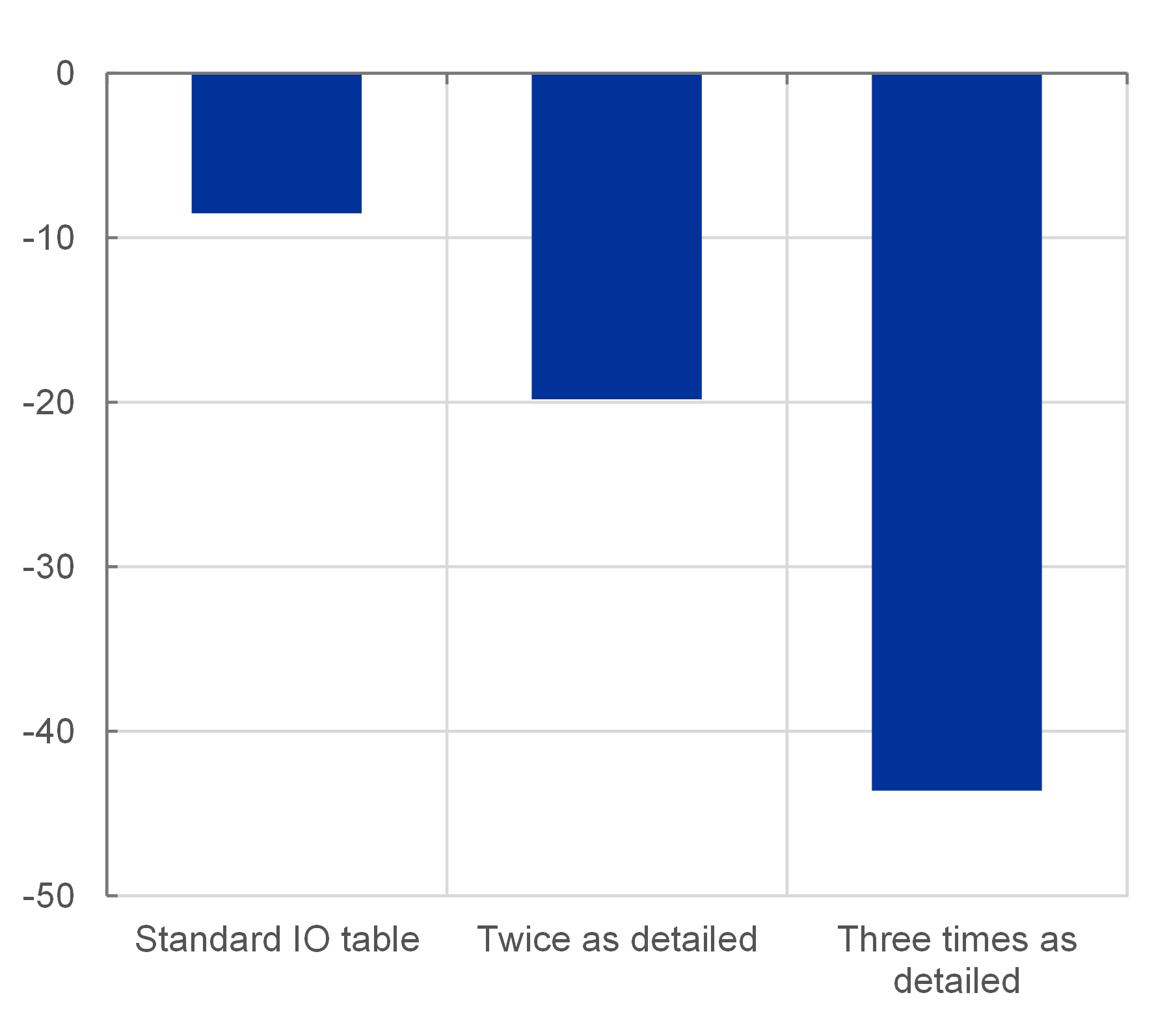
|
b) Role of trade elasticity 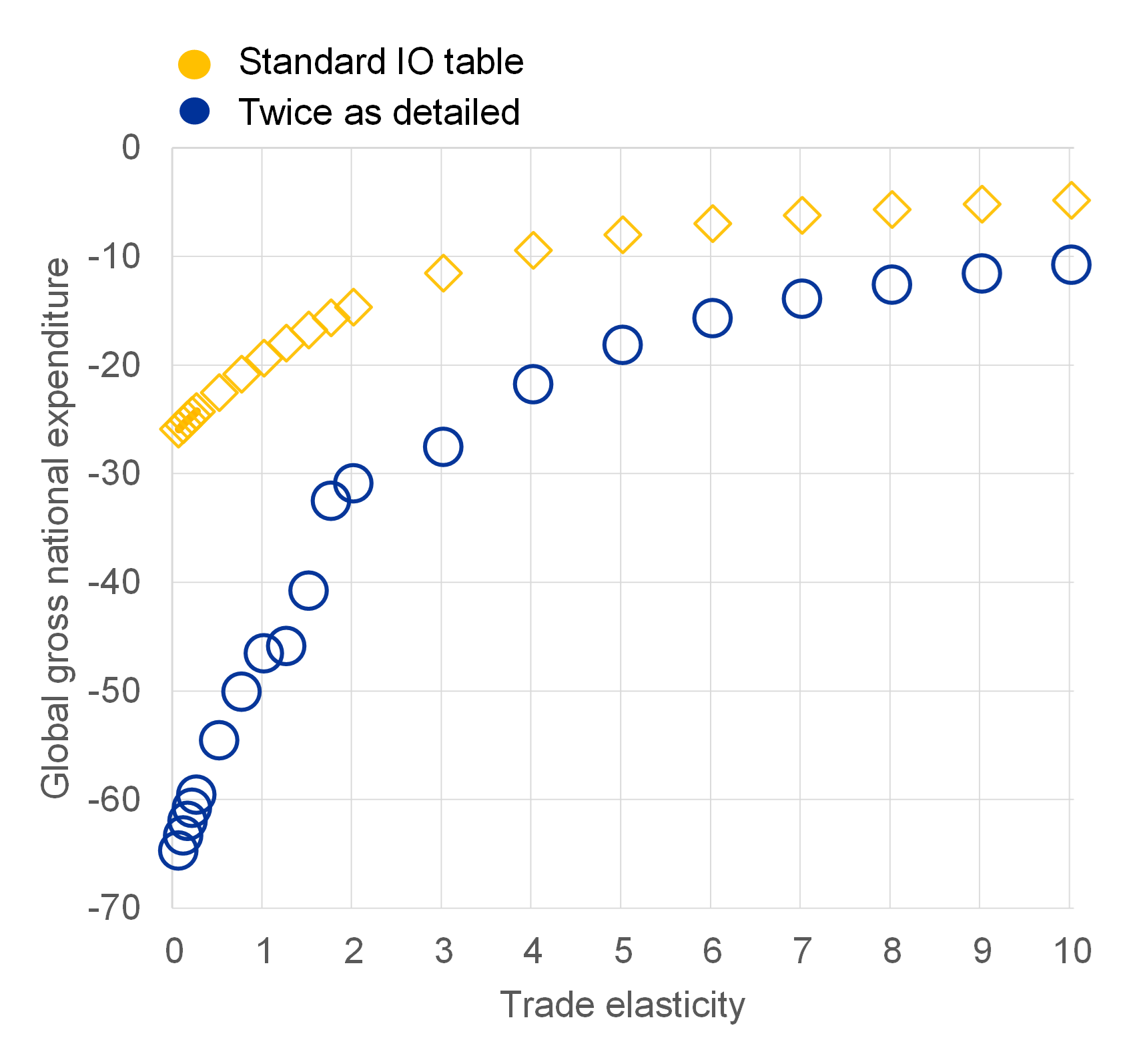
|
Sources: Baqaee and Farhi (2024); Attinasi, Mancini et al. (2024); the OECD Trade in Value-Added database; the International Energy Agency; the CEPII-BACI dataset; and the authors’ calculations
Notes: The non-linear impact is simulated through 25 iterations of the log-linearised model. Panel a) shows welfare losses of an autarky shock under alternative calibrations of the multi-country, multi-sector model. “Standard IO table” refers to a calibration of the general equilibrium model using a standard inter-country input-output (ICIO) table. “Twice as detailed” refers to a calibration of the model where we increase the number of sectors in the ICIO table twofold. We do so by separating sectoral supply (of goods and services) in the ICIO table into supply by two artificial subsectors, each accounting for 50% of the original sector supply. Likewise, we separate sectoral use of (of goods and services) in the ICIO table into use by two artificial subsectors, each accounting for 50% of the original sector use. “Three times as detailed” refers to a calibration of model where we increase the number of sectors in the ICIO table threefold, using the same approach. Panel b) shows welfare effects for different calibrations of the substitution elasticity between different country sources of intermediate input and final good varieties. High values of the elasticity imply high substitutability. “Standard IO table” and “Twice as detailed” refer to the calibrations in panel a).
The true cost of green trade wars must be counted
Policymakers need to consider the true economic and environmental costs of reversing global economic integration for critical green technologies. Our generic method of screening input-output tables for green product supply chains can be seamlessly applied to other product categories such as dual-use technologies or semi-conductors. In an era of increasing geopolitical risks, our new approach makes it possible to explore scenarios by analysing targeted trade policies. Given the real risk of standard inter-country input-output tables underestimating the impact of trade fragmentation, this analysis could produce game-changing insights for decision-makers.
References
Attinasi, M.-G., Boeckelmann, L., de Castro Martins, B., Meunier, B., Borin, A., Conteduca, F.P. and Mancini, M. (2025), “Supply chain decoupling in green products: a granular input-output analysis”, Working Paper Series, No 3152, ECB, Frankfurt am Main.
Attinasi, M.-G., Mancini, M., Boeckelmann, L., Bottone, M., Conteduca, F.P., Giordano, C., Meunier, B., Panon, L., et al. (2024), “Navigating a fragmenting global trading system: insights for central banks”, Occasional Paper Series, No 365, ECB, Frankfurt am Main.
Baqaee, D.R. and Farhi, E. (2024), “Networks, barriers, and trade”, Econometrica, Vol. 92, No 2, pp. 505-541.
Bolhuis, M., Chen, J. and Kett, B. (2023), “Fragmentation in Global Trade: Accounting for Commodities”, IMF Working Papers, No 2023/073, Washington, D.C.
Conteduca, F.P., Mancini, M., Romanini, G., Giglioli, S., Borin, A., Attinasi, M. G., Boeckelmann, L. and Meunier, B. (2025), “Fragmentation and the future of GVCs”, Bank of Italy Occasional Papers, No 932, Bank of Italy, Rome.
Den Besten, T., Di Casola, P., and Habib, M. M. (2023), “Geopolitical fragmentation risks and international currencies”, The international role of the euro, ECB, Frankfurt am Main.
Gopinath, G., Gourinchas, P. O., Presbitero, A. F., and Topalova, P. (2025), “Changing global linkages: A new Cold War?”, Journal of International Economics, Vol. 153.
International Energy Agency, (various years), Global EV Data Explorer; Renewables Data Explorer; Net Zero by 2050 scenario assumptions, Paris.
Javorcik, B., Kitzmueller, L., Schweiger, H., and Yıldırım, M. A. (2024), “Economic costs of friendshoring”, The World Economy, Vol. 47, Issue 7, pp. 2871-2908.
Legal Disclaimer:
EIN Presswire provides this news content "as is" without warranty of any kind. We do not accept any responsibility or liability for the accuracy, content, images, videos, licenses, completeness, legality, or reliability of the information contained in this article. If you have any complaints or copyright issues related to this article, kindly contact the author above.
